


by Mike Cullen
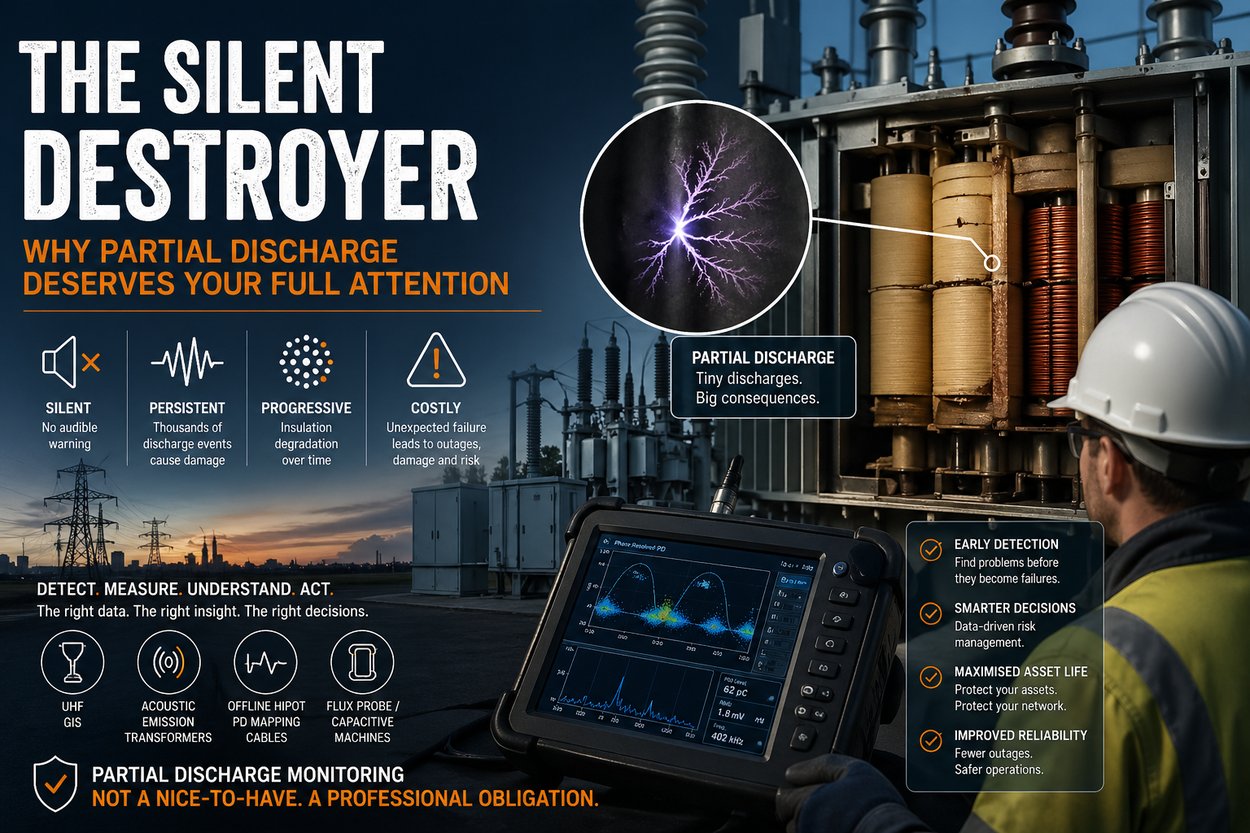
There are failure modes that annunciate loudly. Overcurrents, earth faults, thermal trips. And then there is partial discharge (PD): quiet, persistent, and by the time most teams recognise it, already well advanced.
For engineers managing transformers, cables, switchgear, and rotating machines, partial discharge isn't a peripheral concern. It is one of the most consequential degradation mechanisms in the HV fleet, and one of the most consistently underestimated.
What is partial discharge?
PD occurs when electrical stress in a localised region of insulation exceeds the material's dielectric strength, producing a discharge that bridges only part of the insulation gap. It doesn't constitute a full breakdown, not immediately. But each discharge event erodes the surrounding dielectric material: chemically, thermally, and mechanically.
In solid insulation systems, transformer windings, cable polymeric sheaths, and machine stator bars, the cumulative effect of thousands of repetitive discharge events produces treeing, carbonisation, and progressive void formation. In oil-paper systems, PD generates hydrogen and low-molecular-weight hydrocarbons, producing characteristic dissolved gas signatures that experienced analysts recognise as early warning markers.
The physics are well understood. The challenge is detection.
Why PD evades conventional maintenance
Time-based maintenance schedules were not designed to catch PD. Routine visual inspections won't find it. Even thermal imaging, effective for many degradation mechanisms, has limited sensitivity to the early stages of PD activity in enclosed insulation systems.
PD is measurable. But it requires the right instrumentation at the right intervals, applied with an understanding of the signatures specific to each asset type and construction. UHF sensors in GIS, acoustic emission methods in transformers, offline hipot-based PD mapping in cables, and flux probe or capacitive coupling techniques in rotating machines each demand different expertise and different interpretation frameworks.
The gap between "we know PD exists" and "we have a systematic approach to detecting and trending it across our fleet" is where asset life and network reliability are being quietly lost.
The consequences of getting it wrong
A transformer that has been in service for 30 years in a network now carrying renewable-driven harmonic content and voltage fluctuations is not the same asset it was at commissioning. The insulation has aged. The thermal history has accumulated. And if PD has been active, even intermittently, the residual dielectric strength may be a fraction of its original value.
Failure under these conditions is rarely predictable from nameplate data or maintenance history alone. It requires condition intelligence: PD trend data, dissolved gas analysis, frequency response analysis, and an integrated picture of how the asset has been stressed.
Without it, engineers are making risk decisions based on incomplete information, and the consequences, when they materialise, are rarely minor.
The shift that's needed
The industry is moving toward condition-based and predictive asset management. PD monitoring, whether periodic or continuous, is foundational to that shift for HV insulation systems. The technology is mature. The interpretation frameworks exist. What remains is systematic deployment and the organisational commitment to act on what the data reveals.
For engineers managing ageing fleets in an increasingly stressed grid, partial discharge monitoring isn't a nice-to-have. It's a professional obligation.
Partial discharge diagnostics, detection methodologies, and predictive asset strategies are among the core technical themes explored at the 24th Annual Machines and HV Assets Conference. Join Australia's most experienced HV engineers for two days of applied technical exchange.
For further information, visit https://www.machinesconference.com.au/ today.
Download the Brochure